Quick answer: On November 16, 2026, HHS announced a final rule modifying the HIPAA Privacy Rule, scheduled for Federal Register publication on November 19, 2026. The biggest change: covered entities must respond to patient records requests within 15 calendar days instead of 30, with one 30-day extension still allowed. The rule also changes access fees, requires fee schedules to be posted online, revises the Notice of Privacy Practices, eliminates the signed NPP acknowledgment, and expands disclosures for care coordination. If publication occurs as scheduled, the rule takes effect January 18, 2027, and compliance is required by July 17, 2027. Until then, the current rule, including the 30-day access deadline, still applies and is being enforced.
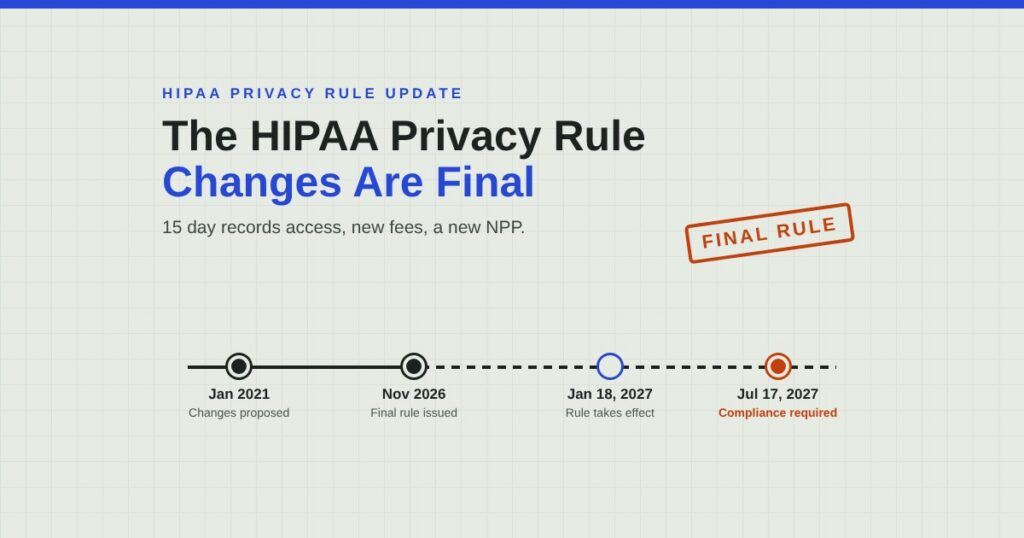
Key Dates
- November 16, 2026: HHS announced the final rule and released a fact sheet.
- November 19, 2026: Scheduled publication in the Federal Register.
- January 18, 2027: Effective date, 60 days after publication.
- July 17, 2027: Compliance date, 180 days after the effective date. HHS is also allowing additional time to update business associate agreements in certain circumstances.
These dates assume publication on November 19; confirm them against the published rule.
What Changes for Patient Access
Right of access is the center of this rule. The final rule:
- Cuts the response time in half. Access must be provided as soon as practicable, and no later than 15 calendar days after the request is received. One extension of up to 30 calendar days remains available.
- Changes access fees. The rule specifies when electronic PHI must be provided at no charge and amends what may be charged for other requests.
- Requires posted fee schedules. Covered entities must post estimated fee schedules on their websites for copies provided under the right of access and under a patient’s authorization.
- Addresses personal health apps. The rule clarifies when a covered entity must provide electronic PHI through an app the patient chooses.
- Formalizes directed transfers. Patients may direct a covered entity to send an electronic copy of PHI in an electronic health record to a person they designate.
- Eases identity verification. Covered entities must reduce the burden of verifying identity for patients requesting access.
What Changes for the Notice of Privacy Practices
What Changes for Care Coordination and Other Disclosures
- Health plans may use and disclose PHI for both population-based and individual care coordination and case management as part of health care operations.
- Covered entities may disclose PHI for individual care coordination and case management to social services agencies, community-based organizations, home and community-based services providers, and similar third parties that provide health-related services.
- Disclosures to Telecommunications Relay Services communications assistants are expressly permitted, and TRS providers no longer require a business associate agreement.
- The permission for mission readiness disclosures now covers all Uniformed Services, adding the U.S. Public Health Service and NOAA Commissioned Corps.
HHS describes the rule as adopting many, not all, of its 2021 proposals. HHS’s summary omits several proposals, including the “good faith belief” standard for family and caregiver disclosures, the “serious and reasonably foreseeable threat” standard, and the minimum necessary exception for care coordination. Do not change policies in those areas until you confirm what the published rule actually says.
What Applies Until July 2027
What to Do Now
- Measure your current turnaround time for records requests by channel, and identify the requests that would miss a 15-day deadline.
- Redesign your access workflow, including who owns requests, how they are logged, and when an extension notice is sent.
- Review your copy fees against the new rules and prepare a fee schedule to post on your website.
- Plan your NPP revision and the matching changes to intake forms and front desk procedures.
- Inventory business associate agreements and confirm which need updating, and on what timeline.
- Train staff on the new requirements before July 17, 2027, and keep meeting the current rule until then.
Frequently Asked Questions
When does the new HIPAA Privacy Rule take effect?
If the rule is published in the Federal Register on November 19, 2026, as scheduled, it takes effect January 18, 2027, and compliance is required by July 17, 2027.
What is the new deadline for patient records requests?
As soon as practicable, and no later than 15 calendar days after receiving the request, with one extension of up to 30 calendar days. The current 30-day deadline applies until the compliance date.
Do patients still need to sign an NPP acknowledgment?
The final rule eliminates that requirement for covered health care providers with direct treatment relationships. Until the rule takes effect, follow the current requirement.
Do we need a new Notice of Privacy Practices?
Yes. The final rule changes required NPP content, including a new right for patients to discuss the notice with a designated contact person or office.
Do we have to post our fees online?
Yes. Covered entities must post estimated fee schedules on their websites for copies provided under the right of access and pursuant to an authorization.
Get Ready for July 2027; Colington Consulting Can Help
Fifteen days leaves little room for a records process that depends on one person or an unwritten routine. Colington Consulting’s lead consultants have personally conducted more than 1,000 HIPAA risk assessments, and we help covered entities and business associates rebuild right-of-access procedures, revise Notices of Privacy Practices, update Privacy Rule policies and business associate agreements, and train staff, so you meet today’s requirements and are ready well before the compliance date.
Get a free HIPAA Risk Review.We will show you where your access process, fees, and NPP stand against the new rule, and where to focus first.
Schedule Your Free HIPAA Risk Review
Sources
U.S. Department of Health and Human Services, Office for Civil Rights, “HHS Issues New Final Rule to Modernize the HIPAA Privacy Rule to Support Coordinated Care and Individual Engagement and Reduce Regulatory Burdens,” press release, November 16, 2026.
U.S. Department of Health and Human Services, Office for Civil Rights, HIPAA Privacy Rule: Changes to Support Coordinated Care and Individual Engagement and Reduce Regulatory Burdens Final Rule, Fact Sheet, November 16, 2026, hhs.gov.
Federal Register, Public Inspection Document 2026-23429, HIPAA Privacy Rule: Changes to Support Coordinated Care and Individual Engagement and Reduce Regulatory Burdens (RIN 0945-AA00), filed November 16, 2026, scheduled for publication November 19, 2026.
U.S. Department of Health and Human Services, Office for Civil Rights, Proposed Modifications to the HIPAA Privacy Rule To Support, and Remove Barriers to, Coordinated Care and Individual Engagement, 86 FR 6446, January 21, 2021.
U.S. Department of Health and Human Services, Office for Civil Rights, Azul Vision, Inc. Right of Access settlement, August 27, 2026, and Shen Smiles, P.C. settlement, October 8, 2026.
45 C.F.R. § 164.520, Notice of Privacy Practices; 45 C.F.R. § 164.524, Right of Access.