A common misconception among medical practices, dental clinics, and physical therapy centers is that the HIPAA Privacy Rule completely outlaws physical or digital patient sign-in sheets.
It does not.
The U.S. Department of Health and Human Services (HHS) explicitly permits the use of patient sign-in sheets. However, they are classified under the “incidental disclosure” doctrine. This means that while a sign-in sheet is a permissible administrative tool, its usage is legal only if your practice implements reasonable physical and administrative safeguards to limit the exposure of Protected Health Information (PHI).
Leaving a highly detailed running list of patient data exposed on a clipboard at the front desk is a compliance failure that invites complaints, OCR scrutiny, and potential penalties.
The Core Rule: What Can (and Cannot) Be Visible
Under the HIPAA Privacy Rule, a sign-in sheet cannot serve as a clinical history log. Other patients standing at the front desk should only see the bare minimum required to check someone in.
Permissible Information on a Sign-In Sheet
Under the HIPAA Privacy Rule, a sign-in sheet is allowed to capture the bare minimum required for basic administrative check-in. It is completely acceptable to ask for the patient’s name, their arrival time, and the name of the specific doctor or provider they are scheduled to see.
Strictly Prohibited Data (HIPAA Violations)
The line is crossed when a sign-in sheet begins to act as a clinical history log. To avoid a compliance violation, a sign-in sheet must never display the reason for the visit or medical symptoms, any medical conditions or diagnoses, insurance provider details, or sensitive personal identifiers like a Social Security Number or Date of Birth.
The Red Line: A patient standing at the counter should never be able to look at the sheet and deduce why the person before them is visiting the clinic. Writing “John Doe — 10:00 AM” is acceptable. Writing “John Doe — 10:00 AM — Chest Pain” or “John Doe — Oncologist Dr. Smith” in a multi-specialty clinic crosses into non-compliant PHI exposure.
What Actionable Safeguards Can Be Implemented for HIPAA-Compliant Patient Sign-In Sheets?
To ensure your sign-in process is legally defensible during a compliance review, your practice must implement operational controls. Relying on an open-face, continuous paper logbook is no longer a best practice.
Implement these three physical and technical safeguards immediately:
1. Peel-Off / Label Sign-In Sheets
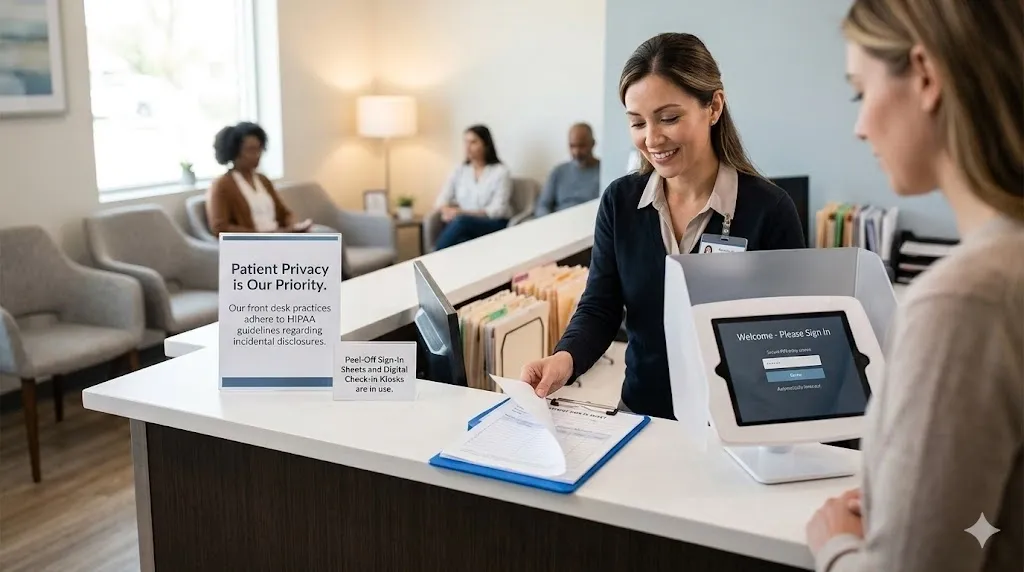
If your practice relies on paper, use a security sign-in sheet system featuring adhesive peel-off strips. When a patient signs in, the front desk receptionist peels off the strip containing the name and takes it to the back office. The next patient only sees a blank backing sheet, completely eliminating the risk of peer-to-peer data exposure.
2. Physical Barrier Controls
Position the sign-in area so it is entirely within the clear line of sight of your administrative staff, but shielded from waiting room occupants. Use privacy screens or desk geometry to ensure that patients standing in line cannot hover over or read the clipboard.
3. Digital Intake Kiosks (Technical Safeguards)
Many modern practices have shifted to tablets or digital kiosks. While an excellent alternative to paper, kiosks introduce technical safeguard requirements. Ensure that:
- The screen automatically times out or clears after a brief period of inactivity.
- Privacy filters are installed on the glass to prevent “shoulder surfing.”
- The software does not display a rolling list of previously checked-in patients on the home screen.
Workforce Compliance: Training the Front Desk
Even the best physical safeguards fail without continuous workforce enforcement. Your administrative staff must understand that handling sign-in sheets requires active risk ownership.
- Turn It Over: If utilizing a temporary paper sheet, staff must flip the clipboard face-down whenever they step away from the front desk.
- Shred Daily: Once a paper sign-in sheet or the peeled backing strips have served their administrative purpose for the day, they must be disposed of in a locked shredding bin. They must never be thrown into a standard trash can.
- Enforce Boundaries: Train front-desk personnel to gently instruct waiting patients to stand back behind a designated marker line until it is their turn to check in.